
ACCOUNT SPOTLIGHT: Southern Maryland Hospital
Centralizing Patient Transport to Unlock Capacity
Centralizing patient transport increased trip volume more than 150 percent and returned thousands of clinical hours to bedside care.
Overview
At MedStar Southern Maryland Hospital Center, patient transport was being managed across individual departments, creating inconsistent workflows and limiting visibility into transport demand. Clinicians often stepped in to move patients when transport resources were unavailable, pulling valuable time away from direct patient care.
To improve patient throughput and free clinical staff to focus on the bedside, hospital leadership partnered with Crothall to implement a centralized patient transport model. The results were transformative: transport capacity increased by more than 150%, annual transport volume grew to more than 75,000 trips, and an estimated 20,000 clinical hours were returned to patient care each year.
-
20,000
Hours of clinical capacity returned to patient care ($1.1 million in clinical labor capacity)
-
75,000
Trips coordinated patient transports annually
-
150
Increase in coordinated patient transport capacity
THE OPERATING ENVIRONMENT
At Southern Maryland Hospital, part of MedStar Health, patient transport (PT) services had been managed at the department level rather than through a centralized program, which created variability in workflows and limited visibility into transport demand across the facility.
Approximately ten transporters completed roughly 25,000 trips annually, while clinicians frequently assisted with patient movement to keep patient flow moving. This often required clinical staff to step away from patient care to support transport needs, contributing to delays during peak periods. Although the program functioned day to day, the decentralized structure made it difficult to coordinate requests or scale services efficiently.
Hospital leadership recognized an opportunity to improve patient throughput and return clinical time to bedside care. They asked Crothall to evaluate the program and determine whether a centralized transport model could deliver greater capacity and more consistent performance without immediately increasing staffing levels.
Crothall provides engaged and thoughtful leadership and has accepted every challenge asked. Patient Transport has evolved into a highly functioning department that provides services to our patients, nursing, pharmacy, lab and the OR. We are grateful for this partnership and have since brought Crothall in to manage two more Patient Transport departments bringing the total six.
Scott Hedding VP Environmental Services & Linen
THE STRATEGIC SHIFT
Crothall introduced a centralized patient transport program designed to coordinate patient movement across the hospital and improve operational efficiency.
The first step consolidated departmental transport staff into a unified program. This created clear accountability, enabled coordinated dispatching, and allowed transport demand to be managed across the entire facility rather than department by department.
To help shape the new model, Crothall used its workforce management platform to assess transport demand, evaluate coverage patterns, and identify operational gaps where labor resources could be better aligned with actual patient movement across the hospital. This helped ensure a centralized model grounded in actual transport activity rather than historical departmental assumptions.
Operational coordination was further strengthened through centralized dispatch support. Dispatch teams act as operational “air traffic control,” coordinating requests, prioritizing urgent needs, and helping transporters move efficiently across the hospital.
MedStar Southern Maryland Hospital Center’s Patient Transport continues to grow and expand their scope of services, playing an important role in keeping patients moving safely and efficiently. Transport is a key driver to patient throughput. Responsiveness and reliability continue to be best in class, giving valuable time back to the patient care team.
Michelle Lundegard VP, Operations
THE IMPACT
Centralizing the patient transport program significantly expanded the hospital’s transport capacity.
Within the first month of implementation, total trip time was reduced by 32%. Within three months, weekly discharge completions increased from 10 to 121, helping improve patient flow and discharge efficiency. Receipt-to- complete performance within 30 minutes also improved from 59% to 81%.
As operational coordination improved, transport activity continued to grow. What had previously been approximately 25,000 annualized trips increased to more than 75,000 coordinated patient transports annually.
The centralized model captured demand that had previously been absorbed across departments, allowing clinical teams to remain focused on patient care while transport responsibilities were managed through a dedicated team.
Performance is monitored through standardized metrics, including receipt-to-arrival and receipt-to-completion benchmarks. Monthly executive reporting allows hospital leadership to review transport performance, identify trends and ensure the program continues to support patient flow and operational efficiency.
By shifting patient movement responsibilities to the transport team, the hospital returned an estimated 20,000 clinical hours annually to bedside care—representing approximately $1.1 million in clinical labor capacity redirected
toward patient care.
Today, the program operates as a more visible, scalable, and performance-driven model supporting patient flow across the hospital.
Improving Throughput Beyond Patient Transport
As PT became more coordinated, downstream operational performance also improved.
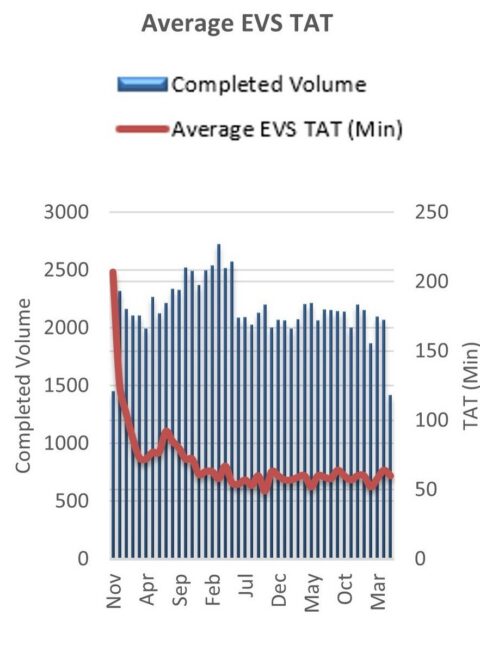
EVS turnaround times decreased dramatically over the measured period before stabilizing near the 50-minute range despite continued transport demand across the hospital.
Real-time discharge workflows allowed EVS teams to receive immediate room turnover notifications as transport assignments were completed, helping environmental services begin room preparation sooner and reducing delays in bed availability.
The story of our transport program is about exceeding expectations. The exponential growth in transport volume signifies the trust we’ve earned and our ability to continuously prove the value.
Shana’e Wyatt PT Director, Crothall Healthcare